
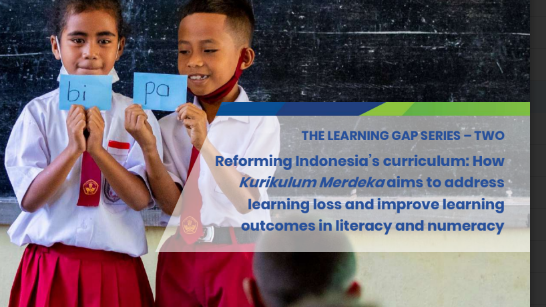
Reforming Indonesia’s curriculum: How Kurikulum Merdeka aims to address learning loss and improve learning outcomes in literacy and numeracy
Purpose
Beginning in late 2019, the Indonesian government embarked on a series of systemic education reforms, collectively referred to as Merdeka Belajar (Emancipated Learning). These reforms are set to improve learning outcomes, promote quality, and equitable education for all Indonesian students by creating changes in the learning paradigm and practice, empowering educators and school leaders, and encouraging active engagement of the entire education ecosystem.
This report is the second in the learning gap study series1. It includes a case study of learning
loss in INOVASI partner schools, adding to the evidence base for why this curriculum reform
is necessary. The study, undertaken by the Centre for Education Policy and Standards (Pusat
Standar dan Kebijakan Pendidikan, or PSKP) of the Ministry of Education and Culture, Research and Technology (MoECRT)2 and INOVASI (Innovation for Indonesia’s School Children)3 highlights the need for a curriculum framework that clearly sets out the key knowledge, understanding, and skills that students need to learn as they progress through school, particularly literacy and numeracy in the early grades. Equally important is the need to develop teachers’ capacities for quality teaching, differentiated learning, and assessment to determine student learning needs and to monitor progress and attainment.
The purpose of this report is to describe the key features of Indonesia’s new curriculum and
its development, and to provide evidence on what policy and support provision will help meet
its aims, especially in the context of COVID-19 pandemic-related learning loss. The report is
intended to inform planning and policy development by contributing to evidence about the
need for an improved curriculum, better quality instruction, and well-designed implementation
to ensure that students across the breadth and diversity of Indonesia have improved
opportunities to learn at school. This is crucial if Indonesia is to address the persistent issue
of low educational attainment and learning loss.
This report endorses the launch of Kurikulum Merdeka (KM; Emancipated Curriculum), elaborating on what, why, and how the new curriculum has come about and how its implementation is expected to contribute to better learning outcomes across regions and groups of Indonesian students.
The series of Merdeka Belajar (Emancipated Learning) initiatives emerged in 2019 from an awareness that Indonesian education has suffered from persistently low learning outcomes, even before the COVID-19 pandemic. The country has been very successful in increasing school participation, especially at the basic education level. Notwithstanding this achievement, the Indonesian education system is not yet competitive internationally. Indonesian students’ performance on the Programme for International Student Assessment (PISA), for example, has not moved from the bottom of the rankings for the past twenty years. During the pandemic, the situation became even more worrying, and inequality is worsening.
The results of the learning gap study undertaken by PSKP and INOVASI provide insights into how learning losses may be recovered and how the learning crisis that existed before the pandemic might be addressed. The current report is the second in a series of reports that analyse the evidence from this learning gap study. The first report, Beyond letters and numbers: The COVID-19 pandemic and foundational literacy and numeracy in Indonesia (Spink et al., 2022), shows that most students did not have foundational literacy and numeracy skills such as listening, decoding, and reading comprehension (which comprises retrieving information, interpreting, and reflecting on text) that are essential if students are to become good readers. Another key finding indicates a gap among expected grade level achievements of students (based on the 2013 Curriculum, the Emergency Curriculum, the Minimum
Competency Assessment (Asesmen Kompetensi Minimum, or AKM) and the Global Proficiency Framework (GPF) and Sustainable Development Goals Minimum Proficiency Level4 (SDG MPL) expectations for literacy and numeracy. For example, for numeracy, some of the Indonesian curriculum expectations were higher than global standards, as indicated by the fact that more Indonesian students achieved the GPF and SDG MPL than the Emergency Curriculum minimum standard. This confirms analysis by Pritchett and Beatty (2015) that in some countries, including Indonesia, the pace of the national curriculum is faster than students’ learning pace. This was found to be true, even for the Emergency Curriculum, which
was an attempt to simplify the 2013 curriculum to focus on core skills during the COVID-19
pandemic. In effect, children are left behind or even stop learning.
Nevertheless, there are some positive and optimistic findings from the ACER study (Spink et
al., 2022). First, providing additional support will enable a large proportion of students to
acquire the expected literacy and numeracy skills. Second, the results demonstrated the
added value of more schooling and teaching, indicated by the positive proportionate increase
in student performance by grade level, with the average performance of students increasing
by years. For instance, while only 16 per cent of Grade 2 students met the SDG’s minimum
proficiency level in math, while the figure doubled up to 32 per cent for Grade 3 students. This
is also the case for literacy scores which increased from 39 per cent to 55 per cent. Third,
students being taught by teachers using the Emergency Curriculum literacy and numeracy
modules scored better than those who did not use it. A regression analysis found that the
difference between the two groups is around 0.1 standard deviation. This may be because the
modules clearly defined skills learning objectives against each level of learning. In addition,
the modules, which were developed as teaching and learning resources for the Emergency
Curriculum, incorporate materials for parents and students to work with and have reduced
competency targets and content, possibly making learning less stressful.
The PSKP-INOVASI learning gap study has highlighted the unequal distribution of learning
outcomes across regions and schools. Thus, it shows the need for a curriculum to facilitate
differentiated learning. Further, the study finds that poor learning outcomes are
disproportionately experienced by children from families who have low literacy, speak local
languages (rather than Bahasa Indonesia), have disabilities, or lack adequate learning
facilities such as books and ICT tools. There are also gender-related differences. Although
boys have lower learning outcomes than girls, the girls were found to suffer a more significant
loss. The study reinforces the need for learning strategies to be adapted to address the
different characteristics and needs of these children and to ensure all children benefit
maximally from their learning.
Teaching students according to their needs requires a systematic approach. Besides the
importance of a more focused curriculum, learning strategies that consider the diverse
conditions and needs of children are also essential for improving the quality of learning
processes and outcomes. Indeed, Indonesia is seeking to undertake significant reform across the system in curriculum, assessment, and teacher development. The reform is potentially a game changer for the
country. Indonesia’s reformed curriculum, Kurikulum Merdeka (KM) is more than just a ‘new
curriculum’. It is accompanied by effort to transform the system, changing the way teaching
and learning take place so that all children can succeed, according to their individual potential.
The reforms focus on the foundational skills of literacy, numeracy, and character education.
The potential scale of the transformative, nation-wide impact of this work is staggering – the
Indonesian education system is the fourth largest in the world with more than 50 million
students, three million teachers, and 300,000 schools; 170,000 of these are primary schools
and madrasah. Kurikulum Merdeka provides a clear articulation of what students are expected to know and be able to do. It is structured with three main features: (1) a focus on essential competencies; (2) flexibility to enable teaching to be adapted to student learning needs; and (3) a project-based learning approach, called Projek Penguatan Profil Pelajar Pancasila (the Pancasila Student Profile Strengthening Project), which will allocate a significant amount of school time to enhance character education and provide real-life experiences to deepen learning and make it more relevant. This new curriculum is aligned with previous initiatives such as the simplification of requirements for lesson plans, the abolition of the high-stakes national examination (Ujian Nasional, or UN) and Nationally Standardized School Examination and the introduction of the National Assessment (Asesmen Nasional, or AN) as a government-run
system evaluation on school performance in place of student individual evaluations. The
system evaluation assesses only literacy, numeracy, and character skills, which are believed
to be three essential competencies every student must possess to become a lifelong learner
and the school climate as contributing to a conducive learning environment. These three
competencies have also been officially established as components of the competence
standard in the new national standard document. The new, sample-based AN will assess and
evaluate school performance. As the AN system shifts from evaluating students to school
performance, it is expected to reduce the stakes while providing important information on
system performance rather than individual performance. This ambitious new curriculum requires comprehensive implementation strategies and ongoing monitoring and refining of the curriculum based on feedback from schools and others.
Given the system scale and unequal resource capacity, incremental adoption of the new
curriculum is essential. Implementation of the new curriculum will require the rearrangement
of existing standards and regulations to empower policymakers and educators and provide
learning tools and resources to expedite the adaptation process. In addition to the earlier
implementation of the Emergency Curriculum, another important modality is that the Kurikulum
Merdeka implementation will be integrated with other Merdeka Belajar initiatives, particularly
the Sekolah Penggerak (Change Agent School), Sekolah Menengah Kejuruan Pusat
Unggulan (SMK PK or Vocational School the Centre of Excellence), and Guru Penggerak (Change Agent Teacher) programs. The programs provide training and mentoring for teachers and schools to help them navigate this new curriculum. A core challenge for Indonesia will be to sustain fidelity of implementation across all schools in Indonesia, with districts assuming responsibility for guiding and supporting implementation and the diversity of school settings across the country. Challenges (discussed in detail in
Chapter 5) will range from the capacity of district personnel to communicate the opportunities
that the new curriculum provides for schools to identify and respond to student needs and
interests; to building the capabilities of school leaders and teachers to provide instruction that
is engaging and ‘at the right level’; to ensuring that all schools have access to the resources,
both online and offline, that have been developed to support schools and teachers.
While one of the greatest challenges will be to implement Kurikulum Merdeka across the
country, early experience of implementation of the curriculum provides a sense of optimism,
with evidence of teachers’ belief and engagement with the new curriculum, and its focus on
students (see Section 5.6). Teachers have welcomed the opportunity to assist their students
to develop important general competencies and have indicated progress with developing
school-based curriculum, implementing project-based learning and applying the flexibility that
the new curriculum provides.
Moreover, INOVASI’s work as a partner to districts and schools has provided convincing
evidence of how capability and confidence can be developed at the local level, which will be
key to leading and managing curriculum change and implementation, as well as a process of
continuous improvement.
Sumber : Kemdikbud
[…] Baca juga : Reforming Indonesia’s curriculum […]